
Terra Mystica
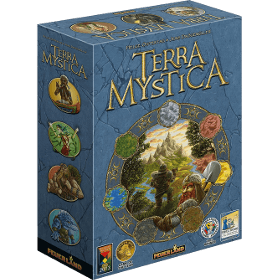 In Terra Mystica each player governs one of 14 factions trying to develop more successfully than their opponents.
Terra Mystica is a magical world: its inhabitants are able to transform the terrain they are living in.
A faction either lives in the Plains, the Swamp, the Lakes, the Forest, the Forest, the Mountains, the Wasteland, or the Desert – and each of them strives to transform the terrain according to its needs.
Antall spillere: 2 - 5
Lengde: 65 mn
Kompleksitet: 4 / 5
Spill Terra Mystica og 1256 andre spill online.
Ingen nedlasting nødvendig - spill direkte fra nettleseren din.
Med vennene dine og tusenvis av spillere fra hele verden.
Gratis.


Spill Terra Mystica og 1256 andre spill online.
Ingen nedlasting nødvendig - spill direkte fra nettleseren din.
Med vennene dine og tusenvis av spillere fra hele verden.
Gratis.
Regelsammendrag
Overview
Terra Mystica is a civilization-building game for 2 to 5 players. At the beginning, you'll choose a faction, each of which has a home terrain and special abilities. As the game progresses, you'll terraform the land, build new buildings, and upgrade existing ones to collect income and score points. The player with the most points after six rounds wins!
Note that certain factions contain exceptions and additions that change or inactivate some rules for themselves.
Game Area Components
At any given moment, each player will have the following resources:
- Workers: White cubes. Usually earned from Dwellings and can be spent to build new buildings.
- Coins: Usually earned from Trading Posts and from taking bonus tiles not chosen by other players. Can be spent to build new buildings.
- Priests: Meeples. These are usually earned from Temples and Sanctuaries. Can be spent to increase position on the cult tracks and to upgrade your terraforming and shipping.
- Power: Purple discs are placed in three bowls, labeled I, II, and III. Power is typically gained from Trading Posts, Strongholds, and from other players building near you. When you gain power, you cycle it from bowl I to bowl II. If bowl I is empty, then you move from bowl II to bowl III. Only the power in bowl III can actually be spent. Doing so moves it back to bowl I. In other words, power needs to be charged twice before it becomes usable.
Players also have the following things in or near their faction boards:
- Buildings: The cost to build each building is given underneath it. When a building is in play, it exposes resources, which can then be earned during the income phase.
- Faction Terrain Cycle: Your faction's home terrain is at the top. All others are in a circle around it, separated by spades. Your buildings can only be placed in your faction's home terrain. On this circle, the closer another terrain is to your home terrain, the fewer spades needed to terraform it into your home terrain.
- Spade Exchange Rate: The higher this is, the fewer workers are needed to terraform a space. (Darklings don't have this.)
- Shipping: The higher this is, the more river spaces you can skip for adjacency. (Dwarves and Fakirs don't have this.)
- Faction Special Ability: Each faction has at least one unique ability. At minimum, you'll have one ability by default, and another when your Stronghold is built.
The board as a whole contains the following features:
- Game Map: Self-explanatory.
- Round Tracker: There are six rounds in the game, each represented by a tile. During each round, building a specific building or taking a specific action awards bonus points. At the end of a round, you will receive an additional bonus based on how far you've advanced on the cult tracks (except during the last round).
- Power Actions: Each provides a bonus when used, and can be claimed by any player for the appropriate power cost. These can each be used once per round.
- Cult Tracks: There are four Cult Tracks: fire, water, earth, and air. Players receive a bonus at the end of each round based on their progress here. At the end of the game, the player who advanced the furthest gets additional points.
- Bonus Tiles: These are worth additional income or bonus points. At any given moment, each player will claim one of them, then exchange them when they pass for the round, so there will be three unclaimed ones to choose from.
- Favor Tiles: These are worth additional income, bonus points, and cult spaces. They are claimed for building a Temple or Sanctuary.
- Town Tiles: These are worth bonus points and some other one-time bonus. They are claimed when a player builds a Town (4+ adjacent buildings with 7+ power).
Setup
Before the game begins, each player does the following:
- In turn order, each player selects a faction to play as.
- In turn order, each player places one of their Dwellings on the map on any hex of their home terrain. (Chaos Magicians don't place a dwelling yet.)
- In reverse turn order, each player places a second Dwelling on the map on any hex of their home terrain. (Nomads will place a third Dwelling. Chaos Magicians place their only Dwelling after all other players.)
- In reverse turn order, each player claims a Bonus Tile. Any bonus tiles not claimed get a coin placed on them (to incentivize them being picked later).
Gameplay
Rounds
Terra Mystica is played across six rounds. Each round is broken into three phases:
- Income Phase: Any icon with an open hand under represents income. These will generally be found on spaces under built buildings, your Bonus Tile, and some Favor Tiles.
- Action Phase: Players take turns taking a single action. This phase ends when all players have passed.
- Cult Phase: Each player gets a bonus based on their progression on any Cult Track specified by the Round Tracker. For every space advanced on the given Cult Track, players get the specified bonus. If this bonus involves terraforming, this is completed in turn order.
Actions
One turn consists of taking one action (with possible free power conversions before or after). Note that certain actions will be worth points based on the Round Tracker.
- Terraform Land: You may terraform one hex through any number of steps. The space you are terraforming must be adjacent to an existing building. At the beginning of the game, each step on your terraforming track costs 3 workers, but this can be improved later. If this space becomes your faction's home terrain (or was to begin with), you may build a Dwelling by paying the appropriate cost. (Darklings pay Priests to do this instead of Workers. Halflings score 1 point for each terraform performed this way. Dwarves and Fakirs may pay a cost to terraform/build one space further away and gain points.)
- Upgrade Building: Replace one building type with another. A Dwelling can be upgraded to a Trading Post. If the building is adjacent to another player's, you pay the lesser cost. Otherwise, the higher cost. A Trading Post can be upgraded to either a Stronghold or a Temple. A Temple can be upgraded to a Sanctuary. If you build a Temple or Sanctuary, you also get a Favor Tile (2 if playing as Chaos Magicians). After building your Stronghold, you get an additional special ability unique to your faction.
- Improve Spade Exchange Rate: By paying the cost given, move your Spade Exchange Rate up one step. You gain 6 VP and reduce the number of workers needed to terraform a hex. (Darklings have no Spade Exchange Rate. Halflings can upgrade at a reduced cost.)
- Improve Shipping: By paying the cost given, move your Shipping up one step (starting at 0, ending at 3). The number of shipping steps equals the number of river spaces you can skip when determining adjacency. (Dwarves and Fakirs cannot do this. The Shipping track for Mermaids ranges from 1-5.)
- Send a Priest to a Cult Track: Move the specified number of spaces up the track. If you pass by any gates containing Power, gain that number of Power. The Priest will remain there for the rest of the game. To advance to space 10 of any track, you need a key. Keys are gained from forming a Town (4+ adjacent buildings with 7+ power).
- Special Action: Take any action indicated by an orange octagon. There are six on the board and cost Power. Each can only be done once per round. Once a player does it, it is "closed". Other actions may be printed on faction boards, Favor Tiles, or Bonus Tiles.
- Pass: Gain any bonus points from your Bonus Tiles or Divine Tiles (Engineers get a bonus if their Stronghold is built), then select a new Bonus Tile. If you are the first player to pass, you will be the first player in the next round. (If "Variable Turn Order" is enabled, turn order will be in the order each player passed. Otherwise, it will proceed clockwise from the first player to pass.) You may no longer take actions for the rest of this round.
Building
If you build anything next to another player's building, they have an option to gain Power. Each building type has a power level associated with it: Dwellings are worth 1, Trading Posts and Temples are worth 2, Strongholds and Sanctuaries are worth 3. For each power level on buildings directly adjacent (i.e., not across any rivers) to the one you built, they can gain 1 power. However, they will also lose VP equal to the amount gained this way minus 1. This action is optional. (If any player accepts this power gain as a result of the Cultists' building activity, the Cultists can advance one step on any cult track.)
If your move results in four or more directly adjacent buildings with a total power level of 7 or more, this forms a Town. If the Sanctuary is one of those buildings, you only need 3. One Divine Tile reduces the power requirement to 6. Towns are worth additional points, a one-time bonus, and an opportunity to advance to space 10 on a Cult Track. Any new buildings directly adjacent to a Town are considered part of the same town and can't be used to form a new one. However, two Towns can be merged once each is established. (Witches and Swarmlings get extra bonuses for forming a Town. Mermaids can include one river tile in their town.)
Before building anything, you have the opportunity to convert Power into resources or downgrade other resources (e.g., turn a Priest into a Worker, or a Worker into a Coin). You may also move any number of power discs from bowl II to bowl III, then remove the same amount of power in bowl II from the game. This can be useful if you need to get power immediately.
End of Game
The game ends after 6 rounds. Each player earns bonus VP based on the following:
- The player with the largest connected civilization earns 18 VP. The second-largest civilization earns 12 VP. The third largest earns 6 VP. Ties involve points being split between players.
- For each Cult Track, the highest player scores 8 VP, the second highest scores 4 VP, and the third highest scores 2 VP.
- Each player earns 1 VP for every 3 coins left in their supply. All resources are automatically downgraded to coins for this. (Alchemists instead gain 1 point for every 2 coins.)
The player with the most points wins!
Factions
For beginners, Witches, Nomads, Mermaids, and Halflings are generally recommended as they have the most straightforward abilities.
| Name | Home Terrain | Initial Ability | Ability from Building Stronghold | Other |
|---|---|---|---|---|
| Alchemists | Swamps (black) | Any time you would be able to do a free conversion, you may trade 1 point for 1 coin, or 2 coins for 1 point. (This last part is done automatically during final scoring.) | Gain 12 power. Each time you terraform (from any action or effect), gain 2 power. | |
| Auren | Forests (green) | -- | Gain a Divine Tile. Gain Special Action that allows you to advance two spaces on any Cult Track. | |
| Chaos Magicians | Wastelands (red) | When you build a Temple or Sanctuary, gain two Divine Tiles instead of one. | Gain Special Action: Take two turns in a row. | You start the game with only one Dwelling, placed after all other players have placed their Dwellings. |
| Cultists | Plains (brown) | When another player gains power as a result of your building activity, advance one step on any Cult Track. If no players chose to gain power, gain 1 power. If no player could gain power, nothing happens. | Gain 7 VP | |
| Darklings | Swamps (black) | When terraforming, you can use one Priest as a spade. Gain 2 VP each time you do this. | You may exchange a Worker for a Priest (up to 3). | Darklings have no Spade Exchange Rate because of their ability to use Priests for terraforming. |
| Dwarves | Mountains (gray) | You may pay 2 extra Workers to skip one hex when terraforming or building a Dwelling. Gain 4 VP each time you do this. When scoring, your largest civilization counts all buildings as if they could be reached with this ability. | You only need to pay one Worker to skip a space for terraforming or building | Dwarves can not use rivers for adjacency (in other words, no Shipping) |
| Engineers | Mountains (gray) | All buildings cost 1 less Worker and 1 less coin (minimum of 1). You may build a bridge for 2 Workers. | When you pass, gain 3 VP for each of your bridges with your buildings on both sides. | The trade-off for the Engineers' ability is that buildings have lower production rates. |
| Fakirs | Deserts (yellow) | You may use 1 Priest to skip one hex when terraforming or building a Dwelling. Gain 4 VP each time you do this. When scoring, your largest civilization counts all buildings as if they could be reached with this ability. | You may use the Priest to skip two hexes. | Fakirs can not use rivers for adjacency (in other words, no Shipping) |
| Giants | Wastelands (red) | You must pay the cost of two terraformings (i.e., 6 Workers, if no Spade upgrades have been taken) to change any hex into Wasteland | Gain Special Action: Terraform any land into Wasteland for no cost. | Because of their initial ability, Giants cannot terraform only by steps |
| Halflings | Plains (brown) | Gain 1 VP each time you terraform | You may terraform up to three steps, which can be split between any number of hexes. If this results in a plain, you may build a Dwelling on it at the appropriate cost. | |
| Mermaids | Lakes (blue) | Shipping ranges from 1 to 5 (instead of 0 to 3). Towns can include one river space, allowing Towns to cross rivers. | Upgrade Shipping once for free. Gain the appropriate VP. | Mermaids start the game with Shipping available. If a Town includes a river hex, your Town Tile is placed on that river hex. |
| Nomads | Deserts (yellow) | During setup, place a third Dwelling after all other players have placed two. | Gain Special Action: Terraform one hex into a desert for free. You may build a Dwelling on this hex immediately (paying the appropriate cost). Does not work across a bridge or using Shipping. | |
| Swarmlings | Lakes (blue) | All buildings cost 1 Worker more and 1 coin more than usual. Gain 3 Workers when you build a Town | Gain Special Action: Upgrade a Dwelling to a Trading Post for free. | The trade-off for the Swarmlings' ability is that buildings have higher production rates. |
| Witches | Forests (green) | Gain 5 VP when you build a Town. | Gain Special Action: Build a Dwelling for free on any forest hex, regardless of adjacency. |
Expansion Content: Special Landscapes
General Rules:
- Each Faction may place only one special landscape!
- Unless stated otherwise, the special landscape may be placed during the Action phase instead of a regular
Terrain tile when transforming Terrain into your Home Terrain.
- You may NOT place the special landscape during the Cult Bonus phase.
- The special landscape is considered a Structure with a Power value of 1:
- It counts towards forming a Town.
- You get Power when another player builds next to it.
- The other players get Power when you place it directly adjacent to their Structures (or special landscape).
- It counts towards the Area Scoring and the Final Scoring tiles.
- Unless stated otherwise, the special landscape is not considered any of the existing types of Structures.
Especially, it is NOT considered a Dwelling and, therefore, any tiles providing Victory points for Dwellings (or any other Structure for that matter) do not provide any for the special landscape.
- The special landscape cannot be upgraded into another Structure. Once you have placed it, it will remain
there for the rest of the game.
- When taking the “2 Spades” Power action, if you use the first Spade to transform a Terrain space into the
special landscape, you may not use the second Spade to transform a Terrain space that is solely adjacent to the special landscape.
Auren: Tree of Serenity
Once the Tree of Serenity is placed, every time the Auren advance to space 10 of a Cult, they get 4 Victory points.
Witches: Raven's Blunder
When Raven's Blunder is placed, every time the Witches found a new Town, they must choose between gaining 5 Victory points as usual or advancing 3 steps on a Cult track of their choice.
Alchemists: Gloomy Workshop
After placing the Gloomy Workshop, the Alchemists may immediately and only once do both, advance on the Shipping track and/or lower the Exchange rate for Spades, without paying the Priest cost. They must pay the other resources; and they gain Victory points as usual.
Darklings: Camp
The Camp counts as a Dwelling (so tiles providing Victory points for Dwellings also provide them for the Camp). The Camp cannot be upgraded.
Cultists: Cult Palace
The Cult Palace does not provide any additional benefit during the game. During Cult Scoring, the Cultists break ties, i.e. they are supposed to be half a step ahead of where they actually are in each Cult.
Halflings: Driller
The Halflings pay a total of 1 fewer Spade (but at least 1) every time they transform a Terrain space that is directly adjacent to the Driller.
Dwarves: Great Tunnel
With the Great Tunnel as the starting point, the Dwarves may Tunnel through 2 Terrain spaces instead of just 1. Every time they get Spades as a Cult Bonus, they may Tunnel to spend these Spades (and not paying Workers for that Tunneling).
Engineers: Bridge Tower
When the Bridge Tower is placed, the Engineers gain the ability to build so-called Land Bridges. A Land Bridge must start at one of the six corners of the Bridge Tower and leads along the shared edge of the two Terrain spaces adjacent to that corner. The Engineers must place an actual Bridge piece on that edge. It does not matter whether or not one of these Terrain spaces is a River space; and it does not matter whether or not one or both of these Terrain spaces are occupied by Structures (regardless of whose Structures they are). For instance, a Land Bridge may allow the Engineers to ”break through“ an impassible barrier of opponent Structures. Land Bridges do not interfere with the adjacency of the Structures on the bordering Terrain spaces. Land Bridges count as normal Bridges with regard to the Bridge scoring once the Stronghold is built (i.e. they provide 3 Victory points if the condition for that is met).
Mermaids: Coral Reef
The Coral Reef must be placed on a River space that is directly adjacent to a Mermaid Structure. It does not prevent other players from using that River space for expansion or indirect adjacency. Shipping works with the Coral Reef as with any other Structure. When founding a town containing the Coral Reef, the Coral Reef must be the skipped river space.
Swarmlings: Breeding Ground
Breeding Ground allows a Town to grow even bigger while gaining additional Town tiles:
- At a total Power value of 14, the Town becomes a City, gaining its second Town tile.
- At a total Power value of 21, the City becomes a Metropolis, gaining its third Town tile.
- At a total Power value of 28, the Metropolis becomes a Megacity, gaining its fourth Town tile.
With the appropriate Favor tile ("2 Fire"), these values decrease to 12, 18 and 24, respectively.
Chaos Magicians: Chaos Portal
When the Chaos Magicians build their Stronghold, they may immediately place the Chaos Portal on a free Wasteland space of their choice, anywhere on the game board.
Giants: Cave of Wisdom
When the Cave of Wisdom is placed, the Giants may immediately and only once lower the Exchange rate for Spades at no cost by moving their marker on the Exchange track up one space. If they do, they gain the normal 6 Victory points.
Fakirs: Flight School
When the Flight School is placed, the Fakirs get 2 Coins every time they use their Carpet Flight.
Nomads: Trading Camp
Every time another player builds next to the Trading Camp, the Nomads may either take Power at the normal rate or take exactly 1 Coin from the general supply. If they take the Coin, they do not lose any Victory points.
Expansion Content: Fire and Ice Factions
These factions are enabled when using the Fire and Ice expansion (which is in development for BGA but not implemented as of this writing).
Acolytes
- Home terrain: Volcanoes (orange)
- To transform any other terrain to fire, pay 3 cult points from any track (4 if the target terrain is the home terrain of another player).
- Any time you would otherwise gain a shovel, instead advance 1 space on any track.
- When you build a stronghold, any time you use a priest to advance on a cult track, advance 1 additional space.
Dragonlords
- Home terrain: Volcanoes (orange)
- To transform any other terrain to fire, remove 1 power token from any bowl (2 if the target terrain is the home terrain of another player).
- Any time you would otherwise gain a shovel, instead gain 1 power token to bowl 1.
- When you build your stronghold, gain 1 power token for each player in the game to bowl 1.
Ice Maidens
- Home terrain: Ice (white)
- When you choose this faction, also choose any other terrain type. No other player may choose or have already chosen a faction of this terrain. This terrain and the ones next to it require 1 shovel in order to terraform to ice. (Nothing can terraform ice into anything else.)
- You start the game with a divine favor of your choice.
- When you build your stronghold, when you pass, you gain 3 points for each temple you have in play.
Riverwalkers
- Home terrain: Any (you choose!)
- When you choose this faction, also choose a home terrain. No other player may choose or have already chosen a faction of this terrain.
- Additionally, place a priest on each non-home terrain on your board. Each time you would otherwise gain a priest, you may instead move one of these priests back your general supply (where it can be gained as normal from here on). Each time you do this, pay 1 coin (2 coins if it's the home terrain of another player).
- Your shipping is locked to 1. (However, the bonus card that increases your shipping can still increase this value.)
- You may place dwellings on any terrain not covered by a priest, and only in places that are within shipping distance of the river.
- You may not terraform by any means.
- When you build your stronghold, immediately place two bridges. These still follow the usual rules for building bridges.
Shapeshifters
- Home terrain: Any (you choose!)
- When you choose this faction, also choose a home terrain. No other player may choose or have already chosen a faction of this terrain.
- Whenever another player gains power as a result of your building activity, you may pay 1 point to gain 1 power token in bowl 3. If no players gained power from this, but still had the opportunity to do this, instead gain 1 power. (But if no player was able to gain power at all, nothing happens.)
- When you build your stronghold, you have access to a new action. This action allows you to spend 5 power or 5 power tokens (from any combination of bowls) to change your home terrain to any other terrain that is not already the home terrain of another player.
Yetis
- Home terrain: Ice (white)
- When you choose this faction, also choose any other terrain type. No other player may choose or have already chosen a faction of this terrain. This terrain and the ones next to it require 1 shovel in order to terraform to ice. (Nothing can terraform ice into anything else.)
- All the power actions on the board cost one less power than they usually do.
- For the purposes of building towns and gaining power from other players, your stronghold and sanctuary are considered 4-power buildings.
- When you build your stronghold, you may take the power actions on the board even if another player has already used them.
Playing with custom board layout
A new custom board layout option is available only in training mode. When the option is selected, at the start of the game any of the player is able to load a custom board from text file (.txt). The file should have the following format:
- max 9 lines
- max 13 columns
- odd and even lines should have different number of columns.
- example 1: if 1st line has 13 columns, second line should have 12, 3rd should have 13, 4th should have 12 etc.
- example 2: if 1st line has 12 columns, second line should have 13, 3rd should have 12, 4th should have 13 etc.
- each hex type is represented by a letter: R = Red (Wasteland) Y = Yellow (Desert) U = Brown (Plains) K = Black (Swamp) B = Blue (Reef/Island) G = Green (Forest) S = Gray (Mountain/Stone) I = rIver
Here is an example file content representing the base map:
U,S,G,B,Y,R,U,K,R,G,B,R,K
Y,I,I,U,K,I,I,Y,K,I,I,Y
I,I,K,I,S,I,G,I,G,I,S,I,I
G,B,Y,I,I,R,B,I,R,I,R,U
K,U,R,B,K,U,S,Y,I,I,G,K,B
S,G,I,I,Y,G,I,I,I,U,S,U
I,I,I,S,I,R,I,G,I,Y,K,B,Y
Y,B,U,I,I,I,B,K,I,S,U,S
R,K,S,B,R,G,Y,U,S,I,B,G,R
Here is another example file content representing the Fire&Ice map:
U,I,U,K,Y,I,S,G,R,B,Y,B
R,Y,I,B,S,R,I,I,I,Y,U,K,S
G,K,I,I,I,U,G,Y,I,I,I,I
Y,S,G,Y,K,I,B,R,U,I,G,B,G
I,I,U,I,I,R,K,G,S,I,U,K
G,R,I,I,G,I,I,I,U,B,I,S,R
S,I,Y,S,B,R,G,I,R,S,I,K
K,B,I,K,U,S,B,I,Y,K,I,R,B
S,G,I,R,Y,K,Y,I,B,U,I,U
Fast auction explanation
(explanations taken from https://steamcommunity.com/sharedfiles/filedetails/?id=2506595080, check the link for extra details and example)
Summary
All players will select a faction that will be put up for auction. Players will simultaneously and secretly bid how many VP they are willing to lose in order to win that faction. After all players enter in their maximum bids, the auction proceeds automatically with each player maximizing their own personal value. The starting turn order is tied to the factions themselves, so the first faction listed in the auction will be the starting player after the auction is over.
How does it work?
When setting the maximum bids, each player is essentially predicting what the final scores of each faction will be. For example, let’s say the current factions up for bid are Cultists, Giants, and Mermaids and you think the final scores will be something like 135, 120, and 130 if they all started with 40VP. In that case your maximum bids should be 15, 0, and 10 since you are equally happy to take Cultists with a bid of 15 as you are taking Giants at 0.